Winter Driving Tips for Edmonton: A Calm Guide for New Drivers
Winter driving tips for Edmonton: tires, braking on ice, black ice, parking bans, skids and an emergency kit, written for new and nervous drivers.
 Sai Driving SchoolPublished 7 min read
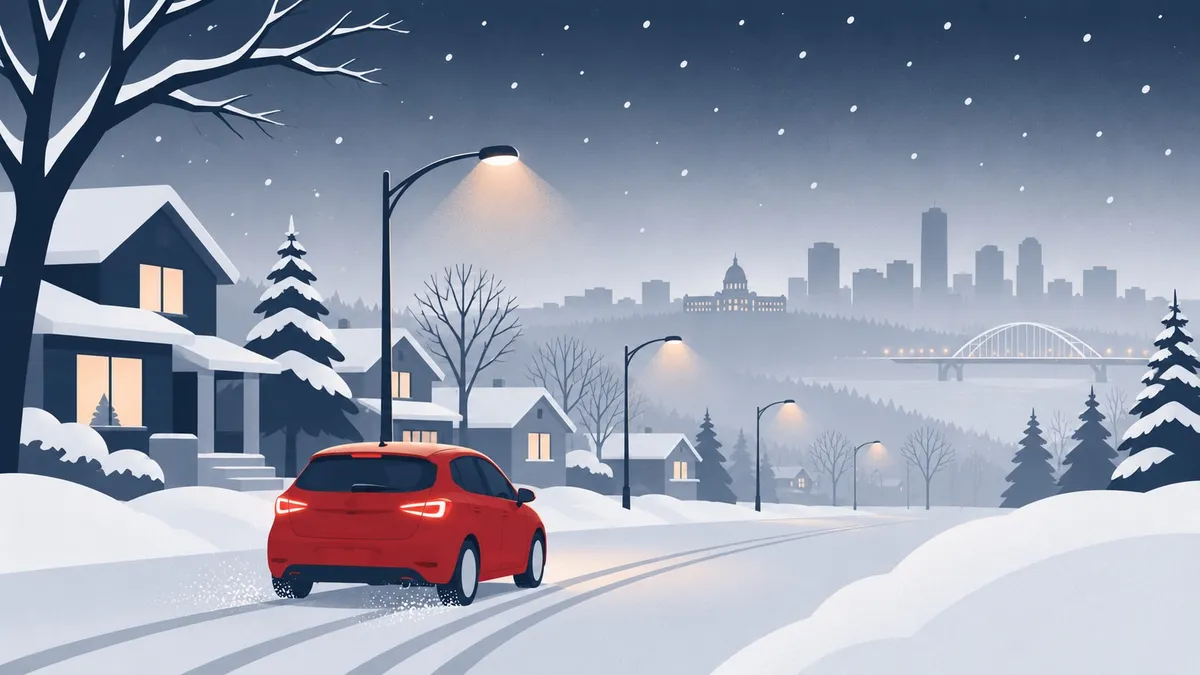
The first real snowfall in Edmonton changes how driving feels. A student who drove fine in September can suddenly feel unsure, and parents often wonder if lessons should wait until spring. Our answer: winter is not a reason to stop learning. It is the best reason to learn properly.
Below are the winter driving tips we give our own students, from tires and braking to black ice, parking bans and what to keep in the trunk. None of it is complicated. Most of it comes down to three habits: slow down, leave space, and be gentle with every pedal and the wheel.
Start with the right tires
Tires are the only part of the car touching the road, so they matter more in January than anything else on the vehicle.
What Alberta law says
Alberta has not made winter tires mandatory. That surprises a lot of newcomers to the province, especially people who have lived in Quebec. Even so, the Government of Alberta’s winter tire guidance recommends driving in severe winter conditions with four winter or all weather tires for better traction and control.
Winter, all weather and all season tires
Here is the difference in plain terms:
- Winter tires use rubber that stays soft in deep cold. The province notes the latest winter tires keep their elasticity at temperatures approaching minus 30°C and below, which is exactly the kind of morning Edmonton gets.
- All weather tires are softer than all season tires and can carry the same winter symbol, but they wear more slowly in summer than a true winter tire.
- All season tires stiffen as the temperature drops, so they grip less on cold snow and ice.
The symbol to look for
Check the sidewall for a peaked mountain with a snowflake inside it. Tires with that mark meet specific snow traction performance requirements. If you are buying a used car this winter, look for it before you hand over any money.
One more point from the provincial guidance: it recommends four winter or all weather tires, not two. Put them on all four wheels so the front and back of the car grip the same way.
Clear the whole car, every time
A peephole scraped in the windshield is not enough. The Government of Alberta’s winter driving tips list what to clear: windows, side mirrors, headlights, taillights and licence plates.
Our routine for students:
- Start the car and turn on the defrost before you begin scraping.
- Brush the roof first. Snow left up there slides onto your windshield the first time you brake, or blows into the car behind you.
- Clear every window, not just the front, so you can actually do your shoulder checks.
- Wipe the headlights and taillights. Other drivers need to see you more than ever in a whiteout.
- Clear the licence plate.
Give yourself an extra ten minutes on snowy mornings. Rushing is how people end up driving with half a windshield.
Braking and following distance on ice
This is where new drivers feel the biggest change.
Leave much more space
The province recommends at least three times your normal following distance on slick roads. In practice, if you would normally count about three seconds behind the car ahead, count nine or more when the road is icy. That space is your margin for a stop that takes far longer than you expect.
Brake early and gently
- Start slowing down well before the intersection. Think about it half a block earlier than you would in summer.
- Squeeze the brake gradually. Sudden pressure is what breaks traction.
- Avoid braking in the middle of a curve. Slow down before it and drive through at a steady speed.
- Never use cruise control in winter conditions. Alberta’s tips say this directly, and it is good advice on Anthony Henday Drive and the Whitemud on a snowy evening.
If your car has ABS
Most modern cars have ABS, the system that stops the wheels from locking. In a hard stop, press the brake firmly and keep pressing. Do not pump it, because the system is already doing that for you, as the SGI driver’s handbook explains. You may feel the pedal pulse and hear clunking noises. That is normal. Students often let go of the pedal the first time it happens, so we practise this in a safe spot until it feels familiar.
Black ice: the hazard you cannot see
Black ice is a thin, clear layer that makes the road look wet rather than white. It catches people out because nothing looks wrong.
Where to expect it:
- Bridge decks and overpasses. The Government of Alberta notes that bridge decks are often slicker than other parts of the road. Edmonton has plenty of them across the river valley.
- Shaded spots where the sun never reaches, such as under overpasses and beside tall buildings.
- Intersections, where exhaust and stopped cars polish snow into ice.
- Early mornings and evenings, after a mild afternoon when meltwater refreezes.
If the road looks shiny when everything around it is dry, treat it as ice. Ease off the gas, keep the wheel straight and avoid braking until you are past it.
How to handle a skid
Every winter driver slides at some point. What matters is staying calm for the two seconds it lasts.
The Government of Alberta’s advice is simple: take your foot off the brake if you start to skid, and steer in the direction you want to go. A few points we add in lessons:
- Look where you want to go. Your hands follow your eyes. If you stare at the pole, you tend to steer into it.
- Make small steering corrections. Big movements cause the car to swing back the other way.
- Rear wheel drive cars can fishtail. Be ready to steer just enough in the opposite direction as the car comes back, so you do not start a second skid.
- Do not slam the gas or brake while the car is sliding.
Edmonton parking bans
Edmonton does not use the term “snow routes”. The City’s program is called Winter Parking Bans, and it comes in two phases. Knowing them saves you a ticket and helps the plows do their job.
Major Roadways (Phase 1)
According to the City of Edmonton, a Phase 1 ban covers arterial roads, collector roads, roads in Business Improvement Areas and bus routes, including bus routes through residential neighbourhoods. It applies 24 hours a day citywide for the clearing period, usually three to four days. Watch for white “Seasonal No Parking” signs.
Residential (Phase 2)
A Phase 2 ban covers residential and industrial areas. Residential roads are bladed to a level snowpack of about 5 cm rather than cleared to bare pavement. The overall ban can last up to 14 days, but each neighbourhood is affected for around 72 hours. Yellow “No Parking” signs go up at neighbourhood entrances at least 24 hours before clearing. Alley parking is not allowed during Phase 2.
What it means for you
- The City gives at least 8 hours’ notice before a ban is enforced.
- You can sign up for Service Notifications on the City’s site and check the Roadways Snow Clearing Map to see when your street is done.
- A vehicle left on the roadway during a ban may get a $250 fine.
For new drivers, a bladed residential street is a good practice surface: packed snow, ruts and windrows teach you more about steering than any dry road will.
Build a winter emergency kit
The Government of Alberta recommends keeping these in your vehicle:
| Category | Items |
|---|---|
| Staying warm | Blanket, extra clothing and footwear, candle in a deep tin, waterproof matches |
| Getting unstuck | Shovel, sand, road salt or non clumping kitty litter, booster cables |
| Seeing and clearing | Ice scraper and snowbrush, flashlight with extra batteries |
| Safety and comfort | First aid kit, fire extinguisher, emergency food, paper towel or rags |
| Finding your way | Cell phone, road map and compass |
Practise in an empty lot first
The best place to feel how a car behaves on snow is somewhere with nothing to hit. A large parking lot that is empty after hours works well, as long as the owner allows it.
A short practice session:
- Accelerate gently from a stop and feel how easily the wheels spin.
- Brake from a low speed and notice how much farther the car travels.
- Try a firm ABS stop so the pulsing pedal is no longer a surprise.
- Make slow turns and feel the front of the car push wide if you go in too fast.
Keep speeds low and have an experienced driver in the passenger seat. Remember that Class 7 learners must drive with a fully licensed driver over 18 sitting beside them.
Book winter practice with an instructor
Snow and ice are exactly when a calm instructor beside you makes the biggest difference. In a lesson we can choose quiet residential streets after a Phase 2 clearing, then build up to busier roads as your confidence grows. Many students also find winter practice takes the fear out of their Class 5 road test, because nothing on test day feels harder than what they have already handled.
If you already drive but want to refresh your skills before the roads get bad, a 2 hour brush up lesson is a good start. New drivers can compare our full packages on the courses page.
Ready for a winter lesson?
Sai Driving School teaches across Edmonton and Sherwood Park, Monday to Saturday from 8 am to 7 pm. Call us at (780) 394-5555 or send a booking request and we will find a time that suits you. If plans change, reschedule with at least 24 hours’ notice at no charge.
Common questions
Are winter tires mandatory in Alberta?
No. Alberta has not made winter tires mandatory, but the Government of Alberta recommends four winter or all weather tires for severe winter conditions. Look for the peaked mountain and snowflake symbol on the sidewall.
How much following distance should I leave on icy Edmonton roads?
The Government of Alberta recommends at least three times your normal following distance on slick roads. On ice, more space is always better, because stopping takes much longer than on dry pavement.
What happens if I leave my car on the street during an Edmonton parking ban?
Vehicles left on a roadway during a City of Edmonton parking ban may get a $250 fine. Phase 1 covers major roadways and bus routes, and Phase 2 covers residential and industrial areas.
What should I do if my car starts to skid?
Take your foot off the brake and steer where you want the car to go. Keep your eyes on your escape path, not on the thing you are worried about hitting.
Can I take driving lessons in winter?
Yes. Winter is a good time to learn with an instructor beside you, because you practise the real conditions you will drive in for half the year. Sai Driving School books lessons Monday to Saturday, 8 am to 7 pm.
Sources
- Winter Tires (Government of Alberta)
- Winter driving tips (Government of Alberta)
- Winter Parking Bans (City of Edmonton)
- Braking (Saskatchewan Driver's Handbook, SGI)
Rules change. For official requirements, check alberta.ca or ask a registry agent. Questions about lessons? Call (780) 394-5555.